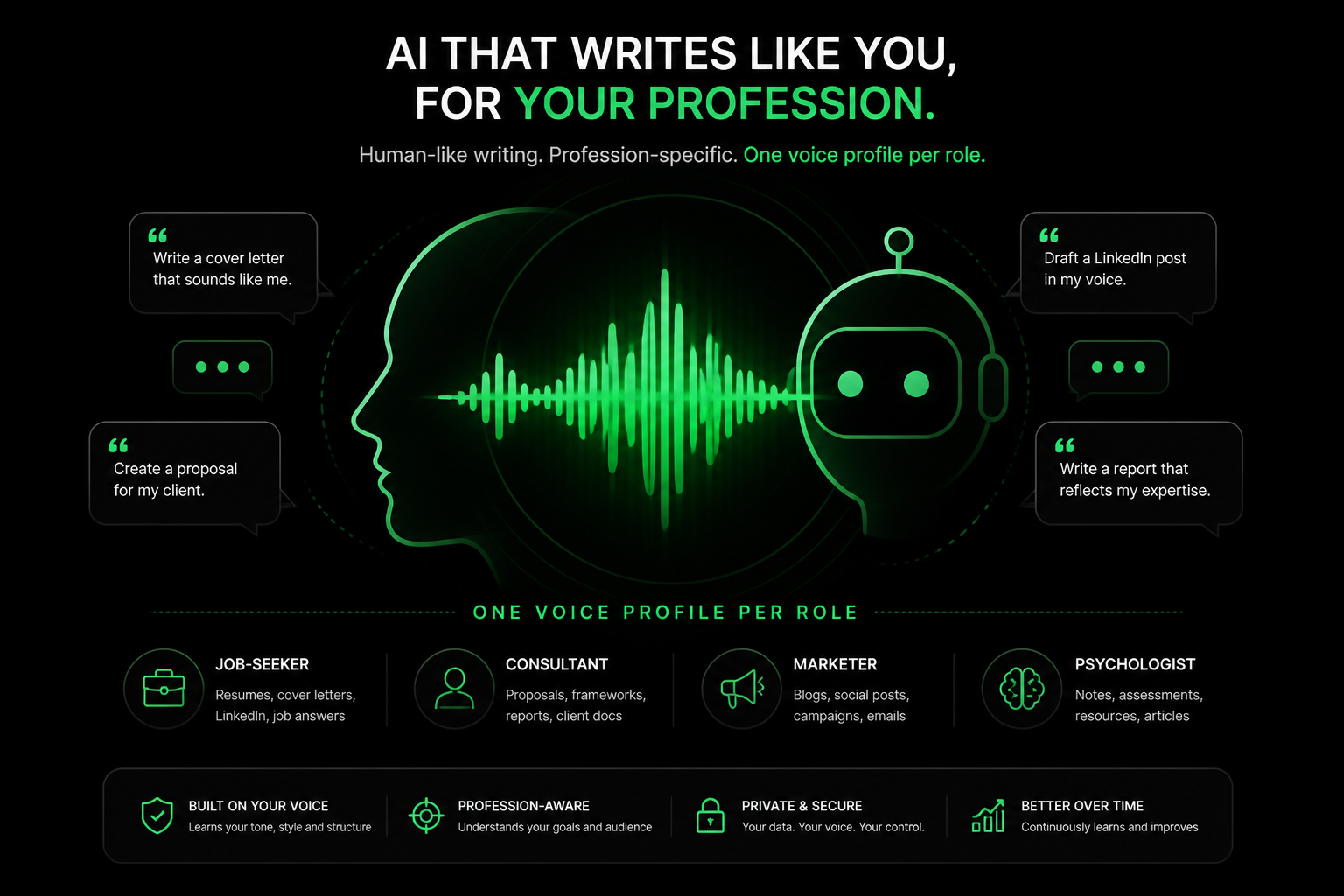
Human Voice — Teaching AI to Stop Sounding Like AI
Why I built a library of profession-specific writing skills, and why "write professionally" is the wrong instruction to give an LLM.
Every AI-generated cover letter leads with the wrong thing. Every proposal reads like marketing copy. Every client email sounds like it came out of the same template — because, functionally, it did. That’s the problem Human Voice is built to fix.
The actual problem
The instinct when AI writing sounds generic is to add more tone guidance: “write professionally,” “sound more confident,” “be concise.” None of it works for long, because tone isn’t the problem. A consultant’s proposal and a job seeker’s cover letter aren’t solving the same problem — one is building trust through credibility signals, the other through fit and motivation. Giving both the same style adjective just produces two equally generic documents with different fonts.
What it does
Human Voice is a library of self-contained, platform-agnostic writing skills — one markdown file per profession. Each skill encodes how a real professional in that role actually communicates: what to lead with, what to cut, which phrases are dead giveaways of AI authorship.
A few things that make it work in practice:
- Each skill is a single, dependency-free markdown file with a
ProfileandInstructionssection — no build step, no framework - Works anywhere: system prompt, custom instruction, or a
.claude/skills/<name>/SKILL.mddrop-in. No lock-in to ChatGPT, Claude, Cursor, or Gemini specifically - Document-aware — the job-seeker skill treats a cover letter, a recruiter follow-up, and LinkedIn outreach as three different documents with three different rules, not one generic “job search tone”
- Skills ship with explicit banned-phrase lists, not just vibes — “I am writing to express my interest” is banned outright, not just discouraged
What I learned building it
The lesson that generalizes past this project: encoding the purpose of a document — what trust problem it’s solving, what the reader needs to decide — produces better output than encoding a style. “Sound professional” is a style instruction. “This document needs to prove fit without sounding desperate” is a purpose instruction, and it’s the one that actually changes what the model writes.
Source and the full skill library are on GitHub.